A lot of homeowners think of the in-home measure as a box to check before the real work starts. It is actually the appointment that decides whether your project comes in on budget or turns into a string of change orders. Here is what our measure tech is really doing while they walk your house.
Squaring the numbers
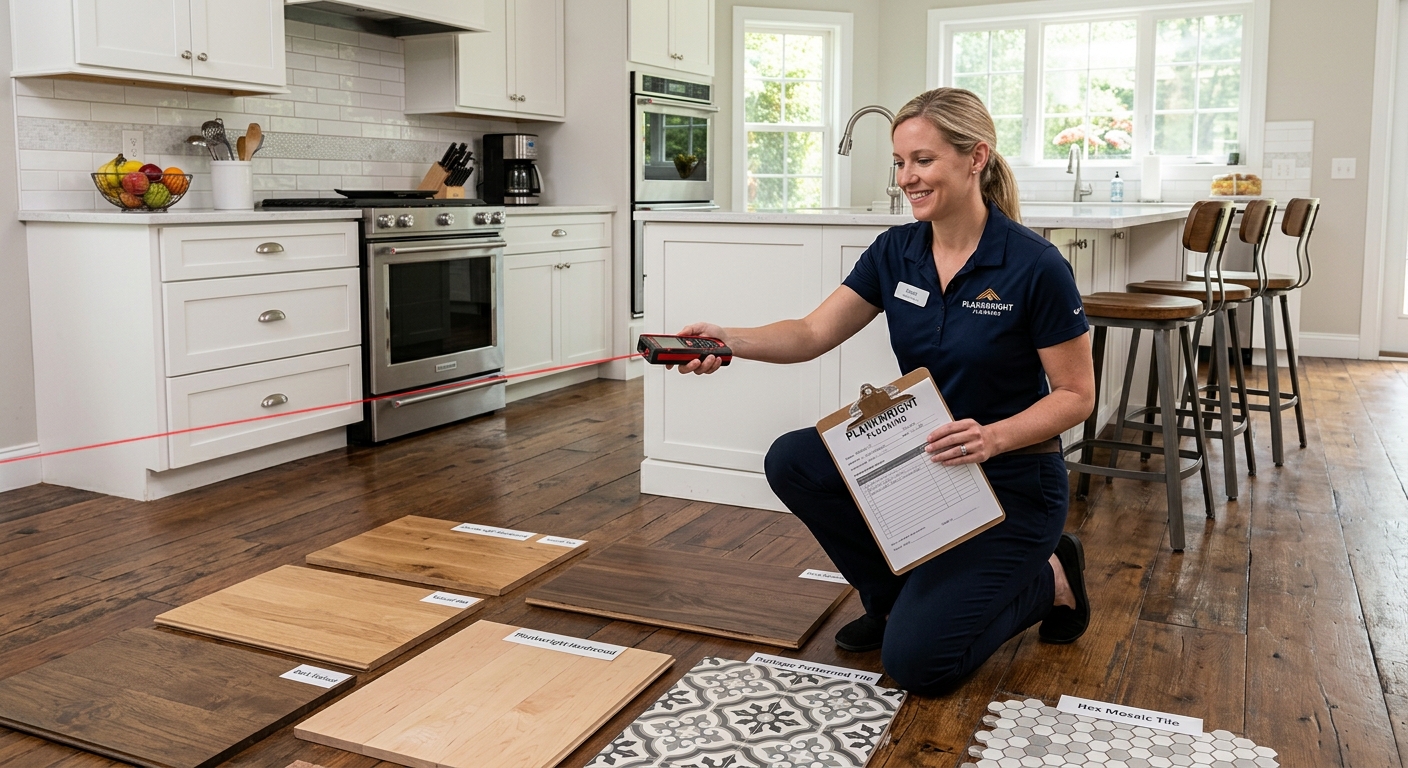
Rooms are rarely the tidy rectangles a quick tape measure assumes. We laser-measure every space, account for closets, transitions, and out-of-square walls, and add the correct waste factor for the material and the layout direction. Order too little and the job stalls waiting on a second delivery, often from a different dye lot. Order too much and you paid for boxes you did not need. Getting this right is the whole point.
Reading the subfloor
This is where the money hides. We check the subfloor for flatness, moisture, and squeaks, because a floor is only ever as good as what it sits on. A slab that needs leveling, a moisture reading that rules out solid hardwood, or a soft spot that needs a board replaced are all far cheaper to catch now than to discover mid-install. A quote written without this step is a guess.
Matching material to the real space
We bring room-matched samples so you can see your candidate floors in your own light, against your own cabinets and trim, instead of under showroom spotlights. Light changes color dramatically, and a plank that looked perfect in the store can read completely differently at home. Seeing it in place is how you avoid the most expensive mistake of all, which is not liking the floor once it is down.
By the time the measure is done, you have a firm number, no hidden subfloor surprises, and confidence in the material. That is why we never skip it, and why it is free.